Doug’s PhD Defense

(Photo courtesy GameCity)

For the last three years, I’ve been working on a PhD in design theory and game design, at IT University of Copenhagen’s Center For Computer Game Research. I ended up writing about some of the games I’ve been developing in my life as an indie, including Johann Sebastian Joust, B.U.T.T.O.N., and Dark Room Sex Game.

I finally finished the dissertation this year, and I’ll be giving my “defense” next week, in the form of a public lecture. My talk is going to get quite theoretical, but in case you’re into that sort of thing and will be in Copenhagen, feel free to attend. Abstract and details below!

Continue reading

Aloha! Mutazione Update!

Aloha from Oahu!

Nils and I are here in Hawaii on a work/vacation trip. Last week we drove around the Big Island, and this week we’re staying with my family friends in Lanikai.

The last few months have been extraordinarily busy for me. I submitted my PhD dissertation on March 1, and then the day after I left for GDC, where we had our hands quite full. So, it’s been great to finally escape to some relaxation – I really need it!

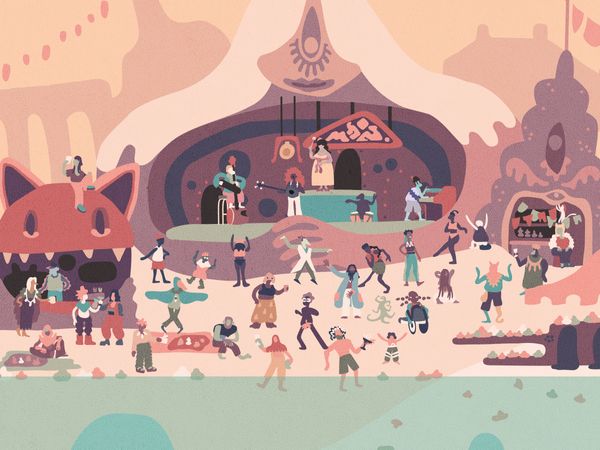
But this trip isn’t all vacation. We’ve come specifically to Hawaii to do some research for our upcoming action-adventure game, Mutazione. The game is going to be a character-driven “swamp soap opera” set in a strange tropical world. The game is originally Nils’ brainchild, and it’s very much driven by his illustrations. We just started production two months ago, so it’s still in the very early stages.

I don’t want to give away too much about the game right now, but what I will share is that Mutazione is going to centrally involve various ecosystems of tropical plant life. So for both Nils and I, it’s been hugely inspiring to hang out in a tropical environment. Here in Hawaii we’ve been spending a lot of time at botanical gardens and in the jungle. We’ve also started to read some biology textbooks on plants and mushrooms. We aren’t so interested in making some kind of biologically accurate simulation, but doing this kind of serious research does open up a lot of game design ideas, and helps Nils with his illustration work. Finding inspiration is important!

Continue reading

We won a Game Developers Choice Award!

(Photo from Official GDC Flickr stream)

Nils and I are currently away on vacation, recovering after an extremely hectic week at the 2012 Game Developers Conference (GDC) in San Francisco. GDC week was a little too busy, but we nevertheless had a very enjoyable and productive trip!

I’ll write more about the trip soon, but for now I just wanted to share the one major piece of news:

Our game Johann Sebastian Joust won the “Innovation” award at the 2012 Game Developers Choice Awards!

We’re so honored and humbled! This award is particularly crazy because we were chosen over some AAA titles like Portal 2 and LA Noire. Wow!

Continue reading

Enter the Stephen

(Of course I had to find a photo with Stephen holding Move controllers)


Exciting news from the factory!

We’re happy to announce that our friend Stephen Ascher has joined the Gute Fabrik team to work with us on our forthcoming action adventure “swamp opera” game, Mutazione. Stephen is going to take the role of Lead Programmer, but he’ll also be helping out on the design (on a team this small, everyone wears multiple hats).

Stephen lives in Montreal, Quebec, which means that we’re going to be working together remotely. But we hope to steal him away to Copenhagen, at least for the summer. I also secretly hope that this will give me an excuse to return to Montreal soon.

Continue reading

The Master of Go

Thanks to a recommendation from my friend Mike, I recently finished reading The Master of Go (1951) by Yasunari Kawabata, a famous Japanese author and Nobel laureate. The book, though semi-fictional (some of the names and details have been changed), follows the story of a famous game of Go from 1938, between the Go master Shusai Meijin and his younger challenger, Kitani Minoru.

I know a little bit about Go, but my grasp of the game’s subtleties is rather tenuous. Nevertheless, Kawabata’s book was still very enjoyable! A deep understanding of Go might provide some additional color to the story, but it certainly isn’t necessary. The book is primarily a character portrait, as well as a chronicle of a specific subculture and a specific time in history (keep in mind that in 1938, World War 2 was looming close on the horizon). Kawabata overarching argument seems to be that the Meijin-Minoru game marks a fundamental shift in how Go was played (at least in Japan). The end of an era, so to speak.

The book is an easy read, and I imagine that most game designers will find it rewarding. For the discerning reader, The Master of Go offers some useful lessons about game design and game culture more generally.

Typically, we tend to think about Go as the shining exemplar of “elegant” game design. It features a simple ruleset, yet also boasts mind-bogglingly complex strategic depth. There’s certainly some truth to that evaluation. But if Kawabata’s tale has anything to teach us, it’s that any competitive game – even Go – is necessarily riddled with awkward ambiguities.

Continue reading

18-Player J.S. Joust!

18-player Johann Sebastian Joust! Yup, we made it happen.

Three armies of six face off in an epic battle. And there’s an additional twist – there’s one traitor lurking on each team! The traitors, though they don’t know who each other are, comprise a secret fourth team. A small rumble at the beginning of the round tells you if you are a traitor. It’s kind of like J.S. Joust meets the famous parlor game Mafia.

The suggestion to introduce backstabbing to the game came from my friend Manveer Heir. Partially inspired by some scenes from Akira Kurosawa’s Ran, I decided it would be more “epic” to have three colored armies, rather than an 18-person free-for-all. Actually, I’ve been joking about calling the installation “Johann Sebastian Bushido.”

Continue reading